Learn when to roll off dumpster rental Knoxville, TN needs...
Read MoreWhat Demolition Contractor in Knoxville TN Checks Before Work
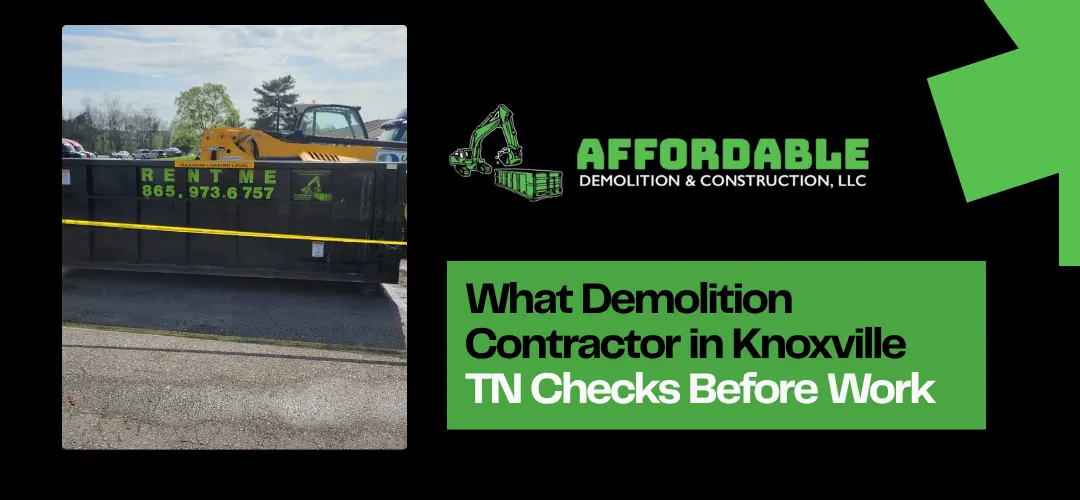
Before demolition begins, the contractor needs to understand what must be removed, what must remain, and what site conditions could affect the work. When hiring a demolition contractor in Knoxville, TN, ask what will be checked before the crew arrives. A clear assessment can help prevent delays, unexpected costs, and damage to nearby property.
1. The Structure and Exact Work Area
The contractor should confirm whether the project involves a full building, garage, interior section, concrete slab, or another feature. Each type of removal requires a different approach, equipment, and work sequence.
Walk the property together and identify what must stay. Point out adjoining buildings, shared walls, fences, trees, retaining walls, driveways, and landscaping that could be affected. For partial demolition, clarify exactly where removal should stop and how the remaining structure will be protected. A written scope helps both parties agree on boundaries.
2. Equipment Access and Debris Removal
Check driveway width, overhead clearance, gates, slopes, ground conditions, turning space, and obstacles. These details help determine how workers, machinery, and hauling vehicles can reach the work area.
Discuss where debris will be staged and how trucks will enter and leave. Limited access can affect equipment selection, the order of work, and loading time. If a sidewalk, driveway apron, or road could be affected, ask whether additional permissions or traffic controls are needed. Clearing the access route before the scheduled start can reduce interruptions. Planning these details is an important part of arranging demolition services Knoxville TN and keeping the project organized.
3. Utility Connections and Underground Lines
Water, gas, electricity, sewer, and other services must be considered before demolition. The contractor should identify visible connections and confirm which utility providers or qualified tradespeople must disconnect or make them safe. Turning off a breaker or closing a valve does not replace proper disconnection.
Underground lines are especially important when removing foundations or slabs. Tennessee requires notice through Tennessee 811 for covered excavation and demolition activity within the required working-day window so underground facilities can be marked. Confirm that utility marking and disconnection steps are complete before digging or operating heavy equipment.
4. Permits, Property Information, and Scope
Permit requirements depend on the structure, project type, and jurisdiction. The contractor should determine whether permits, inspections, or other approvals apply and clarify who will obtain them. The City of Knoxville provides a demolition permit process for total demolition of residential dwellings within its jurisdiction; other structures and locations may have different requirements. Confirm the applicable rules before scheduling work.
Provide available site plans, surveys, renovation records, and details about additions or shared property lines. Get the scope in writing, including what will be removed, what will remain, and what cleanup or restoration is included.
5. Materials Requiring Special Handling
Older buildings and renovation areas may contain materials that need assessment before disturbance. Depending on the building’s age and history, these may include asbestos-containing materials, lead-based paint, refrigerants, chemicals, or other potentially hazardous substances.
Do not rely on appearance alone to identify them. Ask whether specialist inspection or testing is needed and who will arrange it. Demolition contractors Knoxville TN can help clarify the preparation requirements and whether regulated materials need a separate removal process before general demolition. Early assessment helps protect people and prevent delays.
6. Nearby Properties, Safety, and Cleanup
Consider possible effects on neighboring homes, businesses, shared access, and people nearby. Discuss controls for dust, flying debris, noise, equipment movement, and keeping children, pets, tenants, and visitors away from active work areas.
Agree on debris handling before work starts. Ask which materials will be separated, loaded, hauled, and disposed of, and whether final cleanup is included. Concrete, metal, wood, and mixed construction waste can require different handling. Confirm how the site will be left when removal is complete.
7. Review the Estimate Before Work Begins
The estimate should reflect the actual site conditions and describe the removal scope, preparation, labor, equipment, debris hauling, disposal, cleanup, and exclusions. Ask how concealed conditions or additional work will be priced and approved.
Before signing, confirm the expected start date, access arrangements, utility responsibilities, permit status, safety boundaries, and the condition of the property after the job. When comparing contractors, look at the preparation and work included, not only the total price. Review additional project planning considerations before making your final decision. For Knoxville demolition work, a detailed estimate makes it easier to compare contractors fairly.
Discuss Your Project With Affordable Demolition & Construction LLC
Affordable Demolition & Construction LLC provides residential and commercial demolition, interior demolition, concrete removal, selective demolition, and site cleanup in Knoxville and nearby East Tennessee communities. The company states that it assists with permit acquisition and coordinates utility shut-offs with local providers. Share the structure type, property location, access conditions, and what needs to be removed so the team can discuss the next steps. Request an Estimate.
Frequently Asked Questions
Identify the areas to be removed and those that must remain. Gather available property plans, renovation records, utility information, and photos. Make sure the contractor can safely access the work area.
Yes. Relevant services must be properly disconnected or made safe before affected work begins. Coordinate with utility providers and qualified tradespeople rather than relying on switches or valves.
Permit requirements depend on the structure, project scope, and jurisdiction. Check with the relevant local authority and confirm who will obtain required approvals before work is scheduled.
Nearby buildings, fences, driveways, and retaining walls may be affected by equipment movement, vibration, falling materials, or debris. Identifying them early helps determine suitable protection and work methods.
It should state the removal scope, preparation, labor and equipment, debris hauling and disposal, cleanup, exclusions, and how unexpected conditions or extra work will be handled.
Recent Posts
How Waste Dumpster Rental Knoxville, TN Prevents Load Rejections
Learn how waste dumpster rental Knoxville, TN helps prevent load...
Read More
Why Interior Demolition Services Alcoa TN Need a Clear Plan
Explore interior demolition services Alcoa TN and learn how proper...
Read More
Why Dumpster Rental Knoxville, TN Requires Proper Planning
Learn how to plan dumpster rental Knoxville, TN projects with...
Read More
How Interior Demolition Knoxville, TN Makes Room for New Layouts
Explore how interior demolition Knoxville, TN prepares homes for new...
Read More
Affordable Demolition & Roll-Off Dumpster Rental in Knoxville, TN: Complete Project Guide
Affordable Demolition & Construction LLC handles house, mobile home, garage,...
Read More
Mobile Home & Garage Demolition in Knoxville & Maryville, TN: Fast, Safe Structural Removal
Affordable Demolition & Construction LLC handles structural teardown, concrete slab...
Read MoreOffice Timming
Mon - Sat 8:00am - 6:30pm

Copyright © 2025
Design & Developed with ♥ by